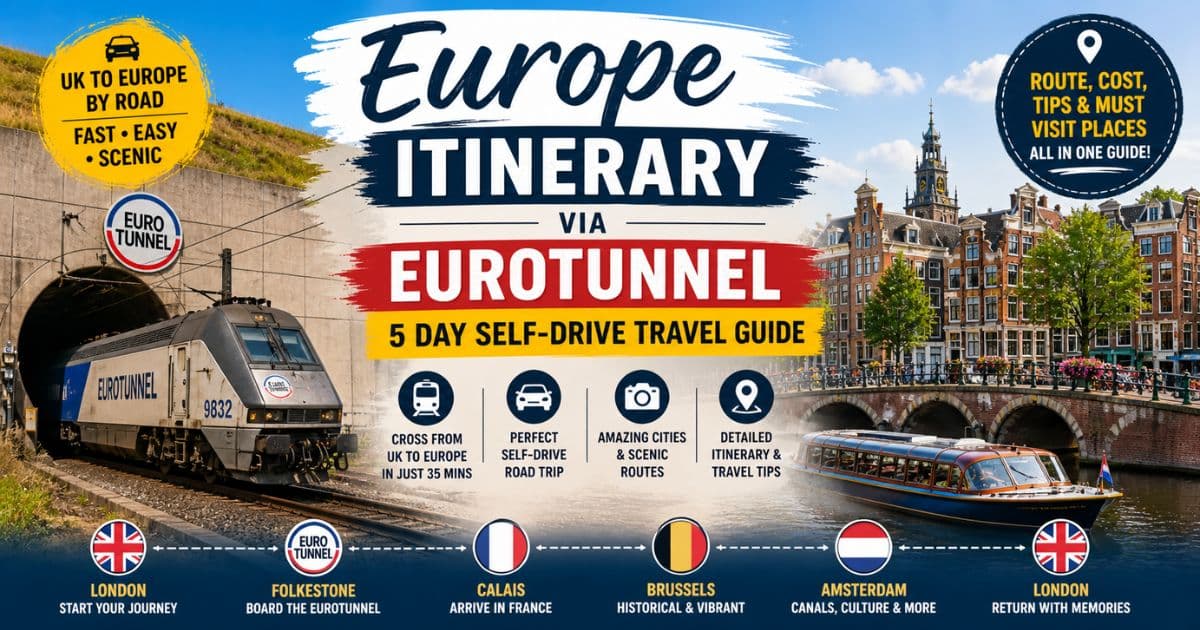
Europe Itinerary via Eurotunnel – 5 Day Self-Drive Travel Guide

Planning a Europe itinerary via Eurotunnel is one of the most rewarding ways to see the continent. You load your car onto a train in Folkestone, England, and 35 minutes later you're in Calais, France, ready to drive.
No airport queues. No checked bags. Just you, your car, and the open road through Belgium and the Netherlands.
This guide covers everything: how Eurotunnel works, what documents you need, a day-by-day 5-day route, costs, and practical driving tips. Whether you're a first-timer or planning your first UK to Europe road trip, this is your starting point.
Before planning your road trip, check out our Europe Travel Planning for Indian Tourists for visa and budget tips.
Europe Itinerary via Eurotunnel – Quick Overview
Eurotunnel (now officially Le Shuttle) runs passenger vehicle services through the Channel Tunnel between Folkestone, England and Coquelles, near Calais, France. Trains run around the clock, with crossings available every 30 to 45 minutes at peak times.
It's the fastest way to get your car from the UK to mainland Europe. The entire crossing takes about 35 minutes once you're on board. Compare that to a standard ferry crossing, which takes 90 minutes to 2 hours, and you'll see why many self-drive travelers prefer the tunnel.
From Calais, you're connected to France, Belgium, the Netherlands, and beyond. A 5-day Europe self-drive itinerary from London covering Brussels and Amsterdam is one of the most popular routes, and it's very manageable even for first-time travelers.
What Is Eurotunnel and How Does It Work?
Eurotunnel is a drive-on, drive-off rail service. You don't leave your car. You drive it onto a flat-bed rail carriage at the Folkestone terminal, the train moves through the Channel Tunnel, and you drive off in Calais.
The route: Folkestone terminal (M20, Junction 11A) to Coquelles terminal near Calais. Distance is about 50 kilometres of tunnel under the English Channel.
Travel duration on board: 35 minutes. Total terminal time including check-in: allow 1 to 1.5 hours from arrival to driving away in France.
Booking is straightforward. Go to the official Le Shuttle website, choose your travel date, car type, and crossing time. You can book one-way or return. Prices vary significantly depending on how far in advance you book and the time of day. Book early to get the best rates.
You arrive at the terminal, go through UK and French border control (passport check), and then drive onto the train. There's a lounge car with refreshments. Some people stay in their cars. Either works.
Documents Required for Eurotunnel Travel
Get these sorted before you travel. Missing any one of them can stop your trip.
- Valid passport: Must be valid for at least 3 months beyond your return date. A UK passport is fine. Indian passport holders need to check validity carefully.
- Schengen visa: If you hold an Indian passport or any non-EU passport, you need a Schengen visa to enter France, Belgium, and the Netherlands. Apply well in advance through your country's French embassy or consulate.
- Driving licence: Your UK or home country driving licence. International Driving Permit may be required depending on your licence country.
- Vehicle registration document (V5C): Proof the car is yours or a letter from the owner if it's borrowed or rented.
- Motor insurance: Your UK policy may not automatically cover Europe. Check with your insurer and get a Green Card if needed.
- GB or UK sticker: Required if your number plate doesn't already have the UK identifier.
- Reflective jacket, warning triangle, and first aid kit: Legally required in France and Belgium.
If you're an Indian traveler based in the UK, double-check your Schengen visa type. A standard tourist Schengen visa covers multiple countries in the zone, so one visa covers France, Belgium, and the Netherlands on this route.
Best Route for a 5 Day Europe Road Trip
Day 1 – London to Calais
Start early. Leave London by 6am to hit the Folkestone terminal by 7:30am. Check-in opens 45 minutes before your crossing. Allow buffer time for border control, especially on busy weekends.
Cross to Calais. Once in France, take a short drive into Calais town if you want a coffee and a walk along the coast. The old fortifications and the Rodin monument near the Town Hall are worth 30 minutes.
Drive on to your overnight stop. Calais to Dunkirk is 30 minutes if you want to visit the WWII memorial sites. Or push ahead toward Belgium. Calais to Bruges is about 2 hours, and Bruges makes a beautiful first night in Europe. Book ahead. It's a popular destination.
Day 1 is mostly travel. Keep it light. Grab dinner in Bruges old town, walk the medieval centre, and sleep well.
Day 2 – Calais (or Bruges) to Brussels
Bruges to Brussels is 55 minutes by road. If you stayed in Calais, it's about 2.5 hours to Brussels directly.
Arrive in Brussels by mid-morning. Park your car and spend the day on foot. The Grand Place, one of the finest town squares in Europe, is the obvious starting point. Give it time. The gold-trimmed guild houses and the Gothic Town Hall look different at different times of day.
Walk to Manneken Pis (5 minutes from Grand Place). Try a Belgian waffle from a street stall, not a sit-down café. The difference in taste and price is real.
Lunch at one of the brasseries near the Sablon area. Moules-frites (mussels and fries) is the Belgian national dish. Order it.
Spend the afternoon at the Atomium if architecture interests you, or the Royal Museums for Fine Arts if you prefer galleries. Brussels has both in the same city, about 15 minutes apart by tram.
Stay overnight in Brussels. The EU district has good mid-range hotels. Book with free cancellation, as Brussels prices fluctuate.
If you're looking for more on Belgium travel for Indian passport holders, that's worth researching before you go for visa and entry specifics.
Day 3 – Brussels to Amsterdam
Brussels to Amsterdam is 3 hours by road, give or take. Drive takes you through Antwerp (worth a quick stop for the cathedral and the old port) and into the Netherlands.
Leave Brussels by 9am. Stop in Antwerp for 90 minutes. The Cathedral of Our Lady houses Rubens paintings. The Grote Markt (central square) is compact and walkable.
Back on the road by noon. Cross into the Netherlands. The landscape shifts noticeably: flat, canal-crossed, with windmills visible from the motorway.
Arrive Amsterdam by early afternoon. Park your car and don't move it for 2 days. Driving in Amsterdam city centre is difficult and parking is expensive. The city is built for bikes and trams.
Afternoon in Amsterdam: walk the Jordaan neighbourhood, rent a bike if you're confident, or take a canal boat tour. The canals look best in late afternoon light.
Day 4 – Amsterdam Exploration
A full day in Amsterdam. This is the relaxed day. No driving.
Morning: Anne Frank House requires a pre-booked timed entry. Book this months in advance. It sells out. The experience is moving and worth the effort.
Afternoon: the Rijksmuseum holds Rembrandt's Night Watch and Vermeer's Milkmaid. Allow 2 hours minimum. The museum café is good for a break.
Evening: wander De Pijp neighbourhood. The Albert Cuyp market runs until 5pm on weekdays. Grab a raw herring (haring) with raw onion from a market stall. It's one of those things you do in Amsterdam.
Dinner in Leidseplein. The square has dozens of restaurants in every price range. Indonesian food (rijsttafel) is widely available in Amsterdam and genuinely excellent, a legacy of Dutch colonial history.
Day 5 – Return Journey
Amsterdam to Calais is about 4 hours. Add the Eurotunnel crossing, and you need to be disciplined about your departure time.
Leave Amsterdam by 7am. Drive south through Rotterdam (take 20 minutes to see the Erasmus Bridge if the route suits) and into Belgium. Take the E19 and E40 motorways to Calais.
Arrive Calais terminal by noon or early afternoon. Check in for your return crossing. You can typically switch to an earlier available crossing at no charge at the terminal if space allows, which can save time if you've made good progress.
Back in Folkestone by early-to-mid afternoon. London by evening, depending on M25 traffic. Check live traffic before you approach the M25. Friday afternoon is brutal. Consider stopping for dinner and letting the congestion clear.
Best Places to Visit During the Trip
Brussels is a city most people underestimate. The Grand Place, the chocolate shops, the comic book museum, and the Belgian beer bars around Delirium Café are all within walking distance of each other. Don't just pass through.
Amsterdam's canals are the visual heart of the city. The UNESCO-listed canal ring is best seen by boat or from the bridges of Prinsengracht and Keizersgracht. Morning, before the tourist crowds arrive, is the best time to walk them.
Food worth seeking out: Belgian frites with mayo (not ketchup), speculoos biscuits, Trappist beers in Brussels, Dutch stroopwafels warm off the market griddle, and Dutch cheese from any market stall in Amsterdam.
You can also explore our Best Places to Visit in the UK before starting your Europe journey.
Eurotunnel Travel Cost Breakdown
Costs vary based on when you book and your travel style. These are approximate figures for 2 adults in a standard car.
- Eurotunnel ticket (return): £80 to £250 depending on how far in advance you book and the time of travel. Book 2 to 3 months ahead for best prices.
- Fuel: Roughly £80 to £120 for the full 5-day route in a petrol or diesel car. Fuel is marginally cheaper in France and Belgium than in the UK. Check current prices.
- Hotels (4 nights): Budget hotels £60 to £100 per night. Mid-range £100 to £180. Amsterdam is the most expensive of the three cities.
- Food: Around £30 to £60 per person per day covering meals and snacks. Belgium is cheaper than Amsterdam.
- Toll roads: France and Belgium have toll motorways. Budget around £20 to £40 each way depending on your exact route. The Netherlands has no motorway tolls.
- Parking: Amsterdam city centre parking is expensive (£5 to £8 per hour). Use a Park and Ride on the city outskirts. Brussels has affordable parking garages near the centre.
Total budget for 2 people for 5 days including tunnel, fuel, hotels, and food: roughly £800 to £1,400 depending on your choices.
Driving Tips for Europe Self-Drive Trip
Drive on the right. This is the single biggest adjustment for UK drivers. The first 30 minutes in France feel strange. Stay conscious of it at every junction and roundabout. Roundabouts in France give way to traffic already on the roundabout, not entering it, the opposite of UK rules in most cases.
- Speed limits: France: 130 km/h motorway, 80 km/h rural roads. Belgium: 120 km/h motorway. Netherlands: 100 km/h motorway (130 km/h on some sections).
- Toll roads: France uses a mix of automatic and manned toll booths. Get a mix of cash (euros) and card. Some booths are card-only. Belgium's motorways are free. The Netherlands is largely toll-free.
- Road signs: Standard European signs. Blue background signs are motorway exits. Green is for regular roads in France. Get familiar with key French words: sortie (exit), péage (toll), toutes directions (all directions).
- Parking in Amsterdam: Avoid driving into the city centre. Use the P+R (Park and Ride) signs on the ring road. Cheap parking, direct tram into the centre.
- Low emission zones: Brussels and Amsterdam both have LEZ restrictions. Check whether your car meets the requirements before the trip. Many older diesel cars don't qualify.
Download Google Maps offline for all 3 countries before you travel. Data roaming charges have returned for UK travellers in Europe post-Brexit. A local SIM card or a Europe data package is worth buying.
Best Time to Travel via Eurotunnel
Spring (April to June) is the best time for this route. The weather in Belgium and the Netherlands is mild, tulip season in the Netherlands runs April to May, and the tourist crowds haven't fully hit Amsterdam yet.
Summer (July to August) is peak season. Eurotunnel tickets cost more. Hotels cost more. Amsterdam is very busy. If you're travelling in summer, book everything months in advance and consider visiting the city early morning to avoid the worst of it.
Autumn (September to October) is a good alternative to spring. Crowds thin out after school terms restart, prices drop, and the light in Belgium and the Netherlands in October is genuinely beautiful.
Winter travel is possible but the days are short (dark by 4pm in December) and some attractions reduce hours. Christmas markets in Brussels and Amsterdam are atmospheric if that's your reason for going.
If you're starting from London, read our London Travel Guide for attractions and travel tips.
Travel Tips for First-Time Travelers
- Start early every day. Motorway traffic in France and Belgium builds by 9am. An early start gives you flexibility and avoids stress.
- Carry euros. Both Belgium and the Netherlands use the euro. France uses the euro. Have at least £150 equivalent in cash for tolls, markets, and situations where cards aren't accepted.
- Pre-book your Eurotunnel crossing. Walk-on rates and last-minute tickets are significantly more expensive. Book the return crossing at the same time as the outbound.
- Plan fuel stops. Fill up when you're at half a tank in France. Some stretches between toll stops have limited services.
- Check your car insurance. Phone your insurer before you travel. Some policies cover Europe automatically. Others charge extra. Get it in writing.
- Anne Frank House tickets: Book online before you leave the UK. This is non-negotiable. The queue for walk-in is routinely 3 to 4 hours.
For Indian travellers planning a Schengen visa road trip from UK, the French embassy processes Schengen applications for trips entering France first, which covers this itinerary. Apply 3 to 4 months before travel.
People Also Ask
Can you drive to Europe from the UK?
Yes. The Eurotunnel (Le Shuttle) lets you drive your car onto a train at Folkestone and off in Calais, France, in about 35 minutes. You then drive through mainland Europe as normal. This is the standard route for UK to Europe road trips.
Is Eurotunnel cheaper than a ferry?
It depends on when you book. Ferries on the Dover-Calais route can sometimes undercut Eurotunnel on price, but the crossing takes 90 minutes vs 35 minutes for the tunnel. Eurotunnel tends to win on speed and convenience, ferry can win on last-minute pricing.
How long does Eurotunnel take?
The rail crossing itself takes 35 minutes. Add 45 minutes to 1 hour for check-in, passport control, and loading. Total time from arriving at the Folkestone terminal to driving away in Calais is around 1.5 to 2 hours.
Do Indians need a Schengen visa for a Europe road trip via Eurotunnel?
Yes. Indian passport holders need a valid Schengen visa to enter France, Belgium, and the Netherlands. Apply through the French consulate if France is your first point of entry on this itinerary. Allow 4 to 6 weeks for processing.
Conclusion
A 5-day Europe itinerary via Eurotunnel covering Calais, Brussels, and Amsterdam is a well-paced, genuinely achievable road trip. The distances are manageable, the roads are good, and the three cities offer very different experiences within a few hours of each other.
The Eurotunnel makes the logistics easy. No flights, no separate car hire, no luggage restrictions beyond what fits in your car. You're in control of your schedule from the moment you drive into Folkestone terminal.
The key is preparation: sort your Schengen visa early if you need one, book your tunnel crossing and hotels in advance, and check your car insurance and vehicle documents before you go. Get those right and the trip runs smoothly.
Europe by road is different to Europe by rail or by air. You see the countryside change. You stop where you want. You carry what you need. It's worth doing at least once.
Ready to hit the road? Start planning your Europe itinerary via Eurotunnel today. Book your crossing early, get your documents sorted, and make the trip you've been putting off.