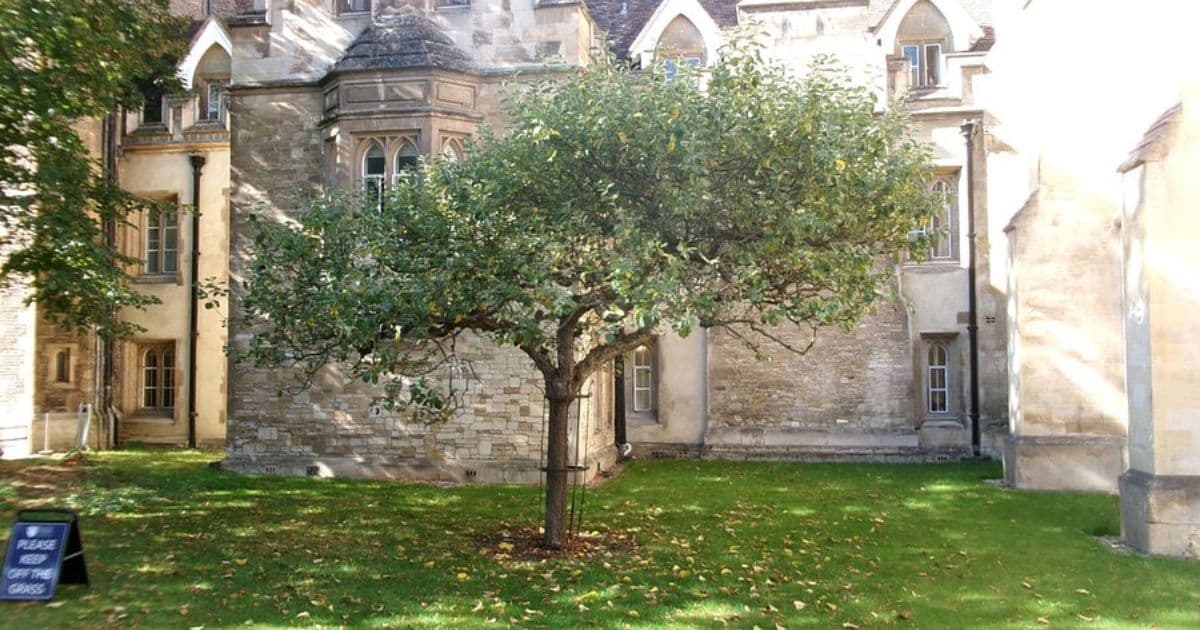
Newton's Apple Tree Cambridge: a complete guide to science's most iconic landmark

Few trees in the world have a story attached to them. Newton's Apple Tree in Cambridge is one of the rare exceptions. Standing outside the Great Gate of Trinity College, it's a direct genetic descendant of the apple tree that Isaac Newton famously watched in his garden at Woolsthorpe Manor in 1666, the same year a falling apple set him thinking about gravity. Millions of tourists walk past it every year without knowing what they're looking at.
This guide covers the full story: where exactly the tree is, how it got to Cambridge, what kind of apples it grows, and what's actually true about the falling apple legend.
Where is Newton's Apple Tree in Cambridge?
The tree is outside Trinity College, on the left side of the Great Gate on Trinity Street. You don't need to enter the college to see it. It's right there on the pavement, a few steps from the main entrance.
Trinity Street runs through the heart of Cambridge city centre. From King's Parade (the main tourist street), walk north for about 3 minutes. You'll pass King's College on your left, then St John's Street, and the Great Gate of Trinity College comes up almost immediately after. The apple tree is on the left as you face the gate.
There's no ticket, no queue, and no charge to see it. You can stand right next to it, photograph it, and read the small plaque nearby. The tree itself is modest in size, nothing dramatic to look at, but that's kind of the point.
If you want to enter Trinity College to see more of the grounds and Newton's old rooms, there's an entry fee. Check Trinity College's website for current prices and opening times, as these change by season.
The story behind Newton's Apple Tree
The original tree at Woolsthorpe Manor
The original tree is at Woolsthorpe Manor in Lincolnshire, about 130 miles north of Cambridge. Newton grew up there, and it was to Woolsthorpe that he retreated in 1665 to 1666 when Cambridge University closed because of the Great Plague.
That period of enforced isolation turned out to be one of the most productive stretches in the history of science. Newton developed his theories on calculus, optics, and gravitation during those roughly 18 months at home.
The original tree is still alive. It's a gnarled, ancient thing that has fallen over and righted itself multiple times across the centuries. Woolsthorpe Manor is now managed by the National Trust and is open to visitors.
How the Cambridge tree was created
The Cambridge tree is a clone, grafted from the Woolsthorpe original in 1954. Grafting is a technique where a cutting from one tree is fused onto the rootstock of another. The resulting tree is genetically identical to the source tree. So the Cambridge apple tree, scientifically speaking, is the same tree as the one at Woolsthorpe Manor.
This matters. It's not a descendant grown from a seed (seeds don't produce genetically identical offspring in apple trees). It's a direct copy. The DNA is the same.
Other Newton apple trees around the world
The original Woolsthorpe tree has been cloned many times over the decades. There are Newton apple tree clones at MIT in Cambridge, Massachusetts; at the National Physical Laboratory in Teddington, UK; and at the Cambridge University Botanic Garden, which has its own specimen separate from the Trinity College tree.
The Botanic Garden clone is worth visiting if you want a quieter, more peaceful setting to see the tree. The Trinity College one gets more foot traffic simply because of its location.
What type of apple tree is it?
The Flower of Kent variety
Newton's apple tree is a Flower of Kent, a variety of cooking apple that dates back to at least the 17th century in England. It's an old variety, rarely grown commercially now, which is part of why seeing a living specimen feels like a small piece of agricultural history on top of scientific history.
The Flower of Kent was a common orchard apple in Newton's time. It's a large, coarse-textured apple bred for cooking, not eating raw.
Appearance of the apples
The apples are large and green with occasional red flushing, roughly the size of a large cooking apple you'd find in a supermarket. They appear in late summer, typically August through September. If you visit in spring, you'll see white blossoms. In early autumn, the fruit is visible hanging from the branches.
Can you eat the apples?
Technically edible, but Flower of Kent apples are cooking apples. Raw, they're very tart and not particularly pleasant. They're meant to be baked or stewed with sugar.
Don't pick them from the tree. This is a protected scientific and historical specimen on college property. Taking fruit isn't permitted and would be disrespectful to the site. Enjoy looking, take your photos, and leave it alone.
The famous gravity story: myth vs reality
Did the apple really hit Newton's head?
No. The idea that an apple bonked Newton on the head is a later embellishment, the kind of story that gets polished over time until it's more dramatic than the original. Newton never said that.
What historical records actually say
The best primary source is William Stukeley, one of Newton's friends and early biographers. In 1726, just a year before Newton's death, Stukeley recorded a conversation in which Newton described sitting in his garden at Woolsthorpe and watching an apple fall from a tree. The falling apple prompted him to think about why it always fell straight down toward the earth, rather than sideways or upwards.
That's the real story. An observation. A question. A line of thinking that led somewhere extraordinary.
Stukeley's manuscript, titled "Memoirs of Sir Isaac Newton's Life," is held at the Royal Society in London. It's one of the closest things we have to Newton's own account of the moment.
How the observation changed science
Newton's thinking about the apple eventually fed into his law of universal gravitation, published in Principia Mathematica in 1687. The argument was that the same force pulling the apple down was also keeping the Moon in orbit around the Earth. One force, two very different scales.
Principia is widely considered one of the most important books in the history of science. The apple in the garden didn't cause it alone, Newton spent years working through the mathematics, but the observation at Woolsthorpe was part of the thread.
Newton's connection to Trinity College
Newton's student years at Cambridge
Newton arrived at Trinity College in 1661 as an undergraduate. He stayed for most of his working life, eventually becoming the Lucasian Professor of Mathematics in 1669, a position now held (more famously) by Stephen Hawking.
His rooms at Trinity were in the northwest corner of Great Court, close to where the apple tree now stands. Whether he ever watched apples fall from a tree at Cambridge specifically is debated; the famous gravity observation is attributed to Woolsthorpe, not Cambridge.
The Great Plague of 1665 to 1666
Cambridge University shut down in 1665 because of the plague. Newton went home to Woolsthorpe for roughly 18 months. He was 23 years old.
During that time, without colleagues, without lectures, without the structured pace of university life, he worked through problems that had been sitting in his mind. The period is sometimes called Newton's "annus mirabilis," his year of wonders. He returned to Cambridge in 1667 with the foundations of calculus, a theory of colour and light, and the seeds of his gravitational thinking already in place.
Visiting Newton's Apple Tree in 2026
Best time to visit
Spring (April to May) is genuinely beautiful. The tree flowers with small white blossoms, and Trinity Street is busy with students and tourists. It's the most photogenic time of year.
Late summer (August to September) gives you the fruit. The green apples hanging from the branches make for better photos and connect more directly to the story.
Winter is quiet. The tree is bare but the street is less crowded, which can be its own advantage.
Photography tips
The tree sits against the stone wall of Trinity College, with the Great Gate directly to its right. The best angle is from slightly across the street, which lets you get the tree and the gate in the same frame.
Morning light works well here. Trinity Street runs roughly north-south, so the east-facing wall of the college gets good light in the first few hours after sunrise. Avoid midday if you want softer shadows.
The tree is smaller than most visitors expect. Crop tightly for the most dramatic shots of the trunk and branches, or go wide to show the context of the college gate behind it.
Nearby places science lovers should visit
The Whipple Museum of the History of Science is a 10-minute walk from Trinity College on Free School Lane. It has a good collection of historical scientific instruments, including items from Cambridge's scientific past. Entry is free.
The Eagle Pub on Bene't Street is where Francis Crick and James Watson announced the discovery of the structure of DNA in 1953. The pub has a wartime ceiling covered in signatures left by RAF and American airmen. Worth the visit on its own, separate from any science angle.
The Cambridge University Botanic Garden has its own Newton apple tree clone, plus 8,000 species of plants across 40 acres. Good for a half-day if the weather is decent.
Why Newton's Apple Tree still matters today
There's something honest about the fact that the tree is unremarkable to look at. It doesn't announce itself. There's no enormous sign, no gift shop, no entry queue. You walk past if you don't know to stop.
But it's a real, living link to one of the most consequential minds in the history of human thought. The DNA in its cells is the same DNA that produced apples in Newton's home garden in 1666. That's a genuinely strange and interesting thing.
For students of science, it's a place worth pausing at. For anyone curious about how big ideas actually start, the apple tree is a useful reminder that the answer is often: quietly, in a garden, watching something ordinary fall.
Conclusion
Newton's Apple Tree in Cambridge is one of those rare places where the story is bigger than what you actually see. A modest tree against a college wall. But its roots, literally and historically, go back to one of the most consequential periods in the history of science.
Whether you're a science enthusiast, a history lover, or just someone who likes finding the less obvious things in a tourist city, it's worth the 2 minutes it takes to stop, read the plaque, and think about what happened in a garden in Lincolnshire 360 years ago.
Plan your visit to Newton's Apple Tree and explore the wider world of scientific history in Cambridge. Travel Nexus World has more guides to help you get the most from every stop.