
HomeDestinationsContinentsCountriesBlog

North Coast 500 Itinerary 7 Days – Ultimate Scotland Road Trip Guide (2026)

North Coast 500 itinerary 7 days

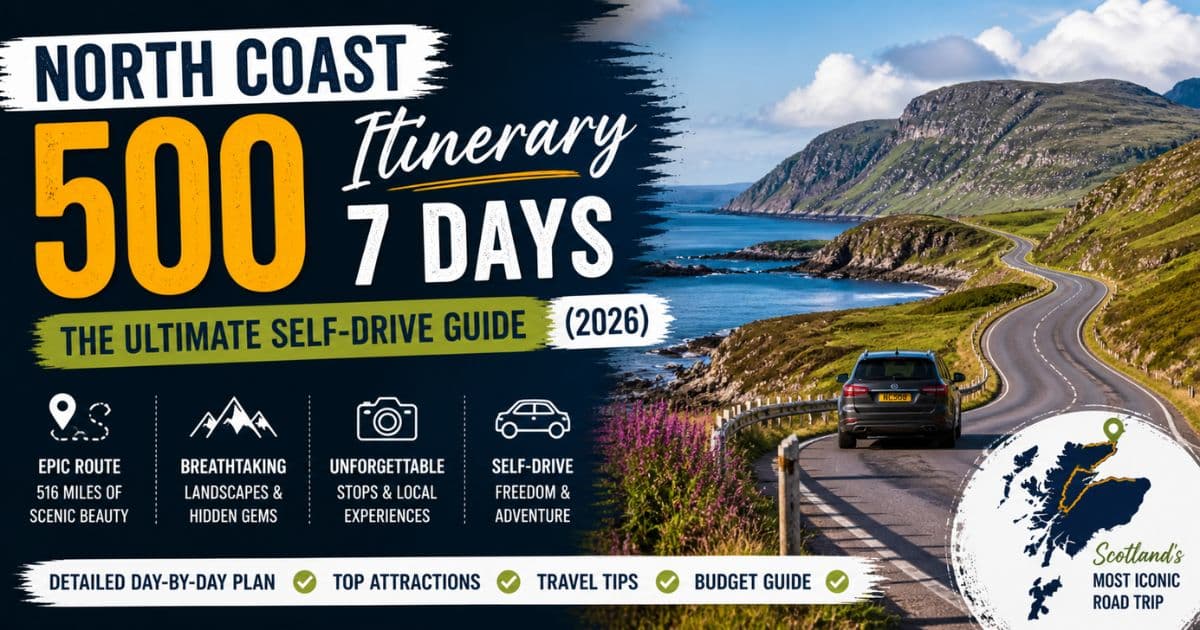
If you are looking for the perfect North Coast 500 itinerary 7 days, you have come to the right place. The North Coast 500 is Scotland's most celebrated road trip a 516-mile circular route that winds through dramatic highlands, empty beaches, rugged coastlines, and ancient castles. It starts and ends in Inverness, and it is one of the most beautiful drives in the entire world.

In this guide, you will get a complete day-by-day plan, the best stops along the route, honest budget advice, and practical tips for first-time visitors. Whether you are driving solo or with family, this guide will help you plan every detail with confidence.

North Coast 500 Itinerary 7 Days – Quick Overview

The North Coast 500 (also called NC500) is a scenic driving route in the Scottish Highlands. It was officially launched in 2015 and has since become one of Europe's top road trips.

Here is a quick summary of the route:

  • Start and End Point: Inverness Castle, Inverness
  • Total Distance: Approximately 516 miles (830 km)
  • Recommended Duration: 7 to 10 days for a comfortable pace
  • Route Direction: Clockwise (west coast first, then north and east)
  • Best For: Self-drive road trips, nature lovers, photography enthusiasts

A 7-day NC500 road trip itinerary gives you enough time to enjoy the highlights without feeling too rushed.

North Coast 500 Route Map and Planning

The NC500 starts at Inverness Castle in the city of Inverness. From there, most travellers drive clockwise heading south-west first along the west coast, then turning north towards Durness, across the north coast, down the east coast, and finally back to Inverness.

Why clockwise? Driving clockwise keeps you on the left side of the road closer to the scenic views. It also means you are not driving directly into the sun during the golden hours of morning and evening.

Before you go, download an offline map using Google Maps or Maps.me. Mobile signal can be very weak or completely absent in many parts of the Highlands.

For those researching the NC500 route map and planning guide, keep in mind that the official route passes through Torridon, Applecross, Ullapool, Durness, Thurso, Wick, and back to Inverness.

Day-Wise North Coast 500 Itinerary

Day 1 – Inverness to Applecross (approximately 100 miles)

Begin your journey in Inverness. Spend the morning exploring the city visit Inverness Castle, walk along the River Ness, and grab supplies for the road ahead.

Drive south-west towards Loch Carron and then tackle the famous Bealach na Ba pass one of the highest and most dramatic mountain roads in Scotland. The views from the top are absolutely stunning, especially on a clear day.

Arrive in the village of Applecross by evening. Have dinner at the Applecross Inn, which is famous for its fresh seafood. Stay overnight in Applecross.

  • Do not miss: Bealach na Ba viewpoint
  • Note: The pass can be closed in severe winter weather. Check conditions before driving.

Day 2 – Applecross to Ullapool (approximately 95 miles)

Drive north along the coast through Torridon. Stop at Beinn Eighe National Nature Reserve Scotland's oldest nature reserve, known for ancient Scots pine forests and beautiful mountain scenery.

Continue through Gairloch, where you can visit a sandy beach and a small fishing harbour. Drive on to Ullapool, a charming white-painted town on the shores of Loch Broom.

Ullapool has good restaurants, shops, and accommodation options. It is a great base for exploring the surrounding area.

  • Do not miss: Corrieshalloch Gorge and the Falls of Measach near Ullapool

Day 3 – Ullapool to Durness (approximately 100 miles)

This is one of the most remote and beautiful stretches of the entire route. Drive north through Assynt, a landscape of dramatic isolated mountains rising from flat moorland.

Stop at Knockan Crag for views across Assynt. Visit Ardvreck Castle, a ruined 16th-century stronghold sitting on the edge of Loch Assynt one of the most photographed scenes in Scotland.

Continue north through Scourie and on to Durness, the most north-westerly village on the Scottish mainland. Visit Smoo Cave, a remarkable sea cave carved by the sea and a freshwater stream.

  • Do not miss: Ardvreck Castle, Smoo Cave

Day 4 – Durness to Thurso (approximately 100 miles)

Drive east along the wild and largely empty north coast of Scotland. This part of the route is less visited but incredibly scenic expect wide open skies, dramatic cliffs, and very few other vehicles.

Stop at Tongue, a small village with views over the Kyle of Tongue estuary. Continue east through Bettyhill, where you can visit Farr Beach and the Strathnaver Museum, which tells the heartbreaking story of the Highland Clearances.

End the day in Thurso, the largest town on the north coast. Thurso has good facilities, supermarkets, and a range of accommodation.

  • Do not miss: Farr Beach, views from the Kyle of Tongue causeway

Day 5 – Thurso to Wick (approximately 40 miles)

Day 5 is shorter in driving distance, which gives you time to explore properly. Start by visiting Dunnet Head the most northerly point on the British mainland, offering dramatic views across to the Orkney Islands on a clear day.

Drive east along the coast to John o' Groats, which is often mistakenly called the most northerly point in Britain (that is Dunnet Head). It is still a fun stop with a famous signpost and good views.

Continue south to Wick, a historic fishing town. Wick Heritage Museum is excellent and gives a real sense of life in the old herring fishing industry.

  • Do not miss: Dunnet Head, Castle of Mey (summer only)

Day 6 – Wick to Inverness (approximately 100 miles)

Drive south along the east coast through the beautiful Caithness and Easter Ross regions. Stop at Dunrobin Castle near Golspie a fairy-tale castle that looks like it belongs in France rather than Scotland. It has stunning formal gardens and a falconry display in summer.

Continue south through the Black Isle peninsula. Stop at Chanonry Point, one of the best places in Scotland to see wild bottlenose dolphins from the shore. Peak dolphin-watching time is around high tide.

Arrive back in Inverness by evening and check into your accommodation.

  • Do not miss: Dunrobin Castle, Chanonry Point dolphin watching

Day 7 – Explore and Relax

Use your final day to revisit a favourite spot, explore Inverness more deeply, or take a short day trip. Loch Ness is just 20 minutes south of Inverness a visit to Urquhart Castle on the loch shore is worthwhile.

You could also explore the Culloden Battlefield, where the last battle on British soil was fought in 1746. It is a deeply moving and historically important site.

In the evening, enjoy a final meal in Inverness and reflect on an incredible road trip.

Best Places to Stop on NC500

Here are some of the best stops on North Coast 500 Scotland that you should not miss:

Beaches:

  • Balnakeil Beach near Durness – white sand and turquoise water, almost like the Caribbean
  • Sandwood Bay – only accessible on foot, one of the most remote beaches in Scotland
  • Achmelvich Beach – crystal-clear water, a hidden gem in Assynt

Mountains and Landscapes:

  • Bealach na Ba pass – the most dramatic mountain road on the route
  • Stac Pollaidh – a short but steep hike with incredible views across Assynt
  • Ben Hope – the most northerly Munro (mountain over 3,000 feet) in Scotland

Villages and Towns:

  • Applecross – tiny, beautiful, and famous for seafood
  • Ullapool – the best-equipped town on the west coast stretch
  • Durness – the gateway to the wild north-west

Best Time to Drive NC500

Summer (June to August) is the most popular time. Days are extremely long in June, it barely gets dark in northern Scotland. The weather is warmest and most of the tourist facilities are open. However, this is also when the midges (tiny biting insects) are at their worst. Book accommodation well in advance.

Spring (April to May) and Autumn (September to October) offer a good balance. Fewer tourists, lower prices, beautiful light for photography, and the midges are far less of a problem. Some accommodation and attractions may have reduced hours, but the route is very driveable.

Winter (November to March) is only recommended for experienced drivers. Roads can be icy, some passes close, and many businesses shut for the season. However, you may see the Northern Lights on clear nights, which is a magical experience.

For most travellers, May or September are the sweet spots good weather, manageable crowds, and excellent value.

How to Plan Your NC500 Road Trip

Car Rental: Book your rental car well in advance, especially for summer travel. Most major car rental companies operate from Inverness Airport. A standard saloon car is fine for the route, but a higher-clearance vehicle gives more confidence on narrow single-track roads. An automatic gearbox can make driving on steep passes easier for those not used to manual cars.

Accommodation: Options range from camping and hostels to B&Bs, self-catering cottages, and hotels. Book early for summer. Wild camping is legal in Scotland under the Land Reform (Scotland) Act 2003 but always follow the Scottish Outdoor Access Code.

Budget Planning: Scotland road trip itinerary costs vary, but a mid-range 7-day trip for two people typically costs between £1,200 and £1,800 including car hire, fuel, accommodation, and food. This guide's budget section below gives a clearer breakdown.

If you are comparing different Scotland road trip itinerary options, the NC500 stands out because it is entirely self-guided, requires no booking fees for the route itself, and can be tailored to any budget or pace.

Budget Breakdown (7 Days)

Here is an approximate budget breakdown for one person driving the NC500 over 7 days. Prices are in British Pounds (GBP) and are estimates for 2026.

  • Car Rental (7 days): £250 – £450 depending on vehicle type and season
  • Fuel (516 miles at average Scottish fuel prices): £80 – £120
  • Accommodation (mix of B&Bs and budget hotels): £70 – £120 per night, totalling £490 – £840
  • Food and Drink (self-catering some meals): £25 – £45 per day, totalling £175 – £315
  • Activities and Entrance Fees: £50 – £100 (many sites are free)
  • Total Estimated Budget (per person): £1,045 – £1,825

Costs can be reduced significantly by camping and self-catering. Travelling as a couple also lowers the per-person cost for accommodation and car hire.

Travel Tips for NC500

  • Drive carefully on single-track roads. Much of the NC500 is single-lane with passing places. Pull into a passing place to let oncoming traffic pass, and never park in a passing place.
  • Fill up with fuel whenever you can. Petrol stations are few and far between in rural areas. Do not let your tank drop below half in remote sections.
  • Pack layers and waterproofs. Scottish weather can change within minutes. Even in summer, warm and waterproof clothing is essential.
  • Respect the countryside. Leave no litter, close all gates, and follow the Scottish Outdoor Access Code at all times.
  • Download offline maps. Mobile signal is unreliable in many areas of the Highlands. Download your maps before you leave Inverness.
  • Book accommodation early. Especially for June, July, and August popular spots sell out months in advance.
  • Allow extra time. The route always takes longer than you expect because you will want to stop constantly for photos and walks.

People Also Ask

How many days are needed for the North Coast 500?

A minimum of 7 days is recommended to cover the highlights comfortably. 10 days is ideal if you want a more relaxed pace with time for hikes and detours.

Is the North Coast 500 worth it?

Absolutely. The NC500 is widely considered one of the world's greatest road trips. The scenery is extraordinary, and the experience is unforgettable for first-time visitors and repeat visitors alike.

Can beginners drive the NC500?

Yes, but beginners should be aware that many roads are single-track with passing places, and some mountain passes are steep and narrow. Drive slowly, be patient, and you will be fine.

What is the best month for the NC500?

May and September offer the best combination of good weather, manageable tourist numbers, and lower prices. Summer (June to August) is beautiful but busier and more expensive.

Conclusion

The North Coast 500 is more than just a road trip it is an experience that stays with you for the rest of your life. From the dramatic mountain passes of the west coast to the wide empty beaches of the north and the historic castles of the east, every single day offers something extraordinary.

With a well-planned North Coast 500 itinerary 7 days, you can cover all the highlights without feeling rushed. Pack your bags, book your car, and get ready for one of the greatest drives on earth.

Start planning your NC500 adventure today Scotland's wild north is waiting for you. Explore more road trip guides on Travel Nexus World to make every mile count.

Frequently Asked Questions

Find answers to common questions

About the Author

Related Posts

Thailand Itinerary 2 Weeks: The Ultimate Travel Guide (2026)

Thailand Itinerary 2 Weeks: The Ultimate Travel Guide (2026)

Plan your perfect 2 week Thailand trip with this complete itinerary — Bangkok, C...

Japan Itinerary 14 Days – Perfect 2 Week Travel Guide (2026)

Japan Itinerary 14 Days – Perfect 2 Week Travel Guide (2026)

Plan your Japan itinerary for 14 days with routes, cities, costs, and tips for a...

P&O Arcadia Current Itinerary 2026 – All Upcoming Cruises & Routes

P&O Arcadia Current Itinerary 2026 – All Upcoming Cruises & Routes

Explore P&O Arcadia Current Itinerary with world cruise, Europe routes, and all ...